Online Radio and Podcasting On The Rise
September 3, 2019
New research shows that online radio and podcasting have been steadily increasing in popularity over the past decade, whereas traditional terrestrial broadcasting has remained steady despite a slow decline in revenue.

According to Pew Research Center, 67% of Americans ages 12 and older have listened to online radio in the past month compared to only 27% in 2009. This growing popularity is even more apparent in the amount of people who have listened to online radio through using a cellphone, with 42% of Americans ages 12 and older having done so compared to a measly 5% in 2010.
Podcasts have also been steadily increasing in listenership. In fact, 51% of Americans ages 12 and older have listened to a podcast at some point in their lives compared to 22% in 2009. The average weekly users of NPR podcasts have been growing steadily as well, with over 7.1 million tuning in every week compared to 2 million in 2014.

In contrast, traditional terrestrial broadcasting has remained relatively steady, with listenership having decreased by only 4% this past decade. The average salary of news analysts and reporters in the radio broadcasting industry has remained at approximately $42,000 for the past decade, while the average salary of editors has increased from $48,551 to $74,000. Despite this, employment within the field of news radio broadcasting is experiencing a sharp decline, with 3,370 new employees being hired in 2018 compared to 4,290 just a decade before then. The total news radio station revenue is also considerably lower than the average news radio station revenue. In fact, the average station generated $2.7 million in 2018 compared to $18 million in total revenue that same year. However, in spite of this economic shift, the ownership of all-news radio stations has remained steady. In fact, Entercom, which was known previously as CBS Corp, owns 10 out of 25 of them.
Thespian Transforms From the Inside Out and the Outside In

By Hannah Kavanagh
Dec. 13, 2018
Blue metal star fixtures and colossal theater production posters stood out against the whitewalls of Angela Pierce’s apartment as she fluffed up her shoulder-length blonde ringlets.
Pierce, 48, is an actress who has been involved in the mediums of both theater and film for over three decades, having worked with Hollywood heavyweights such as Kevin Kline, Tina Fey, and Al Pacino.
Pierce has been immersed in the thespian world since the day she was born. Her father was an actor who would transform into someone else with a different voice, a different posture, a different countenance as the young aspiring actress watched in awe from the orchestra seats. Her mother was a costume designer who would metamorphoseNew York actors into royalty, into star-crossed lovers, into mythical creatures as her daughter scurried off into the dressing rooms backstage. “I watched my dad transform from the inside out and I watched my mom help people transform from the outside in,” she said.
This love of theater continued to manifest itself as Pierce attended the Julliard School, one of the most well-regarded theater conservatories in the world.
However, in the midst of such intense training, her acting career was put on hold.
During her last year at Julliard, Pierce took a bad fall during a dress rehearsal while wearing a corset that was too tight for her, ultimately dislodging the shunt that was placed on a cyst on the top of her liver when she was a baby. Even though she was able to graduate, Pierce was in and out of the hospital for a year and a half after the incident, which in turn robbed her of the opportunity to immerse herself fully in the craft at that time.
Despite the obstacles that initially stood in her way, however, she still manages to remain optimistic and hopeful.
“For my whole health and well-being psychologically and heart wise, I can’t think about [those things], because I think that kind of energy can also get you stuck…It can either get you stuck in a way that you kinda go, ‘Oh, snap out of it. I need to move forward.’ or get you stuck that you never move at all.” said Pierce as her thin golden hoops swayed from side to side and her piercing, doll-like blue eyes stared intently into mine in the crowded Starbucks that we chatted in for well over an hour.
The path of theater certainly did not stop there, however. Pierce continues to work in the acting industry, performing in works such as the show 30 Rock, the play Oslo, and the film You Don’t Know Jack, where her proudest transformations lie. However, she also continues to endure the agonizingly still and dark lulls that is expected from this line of work as she anxiously waits for their agents to send her out on auditions or not hear any word from casting directors despite nailing that last audition that she was passionate about. Despite the lulls though, she manages to keep busy, wipe the sweat from her brow, and shop various plots for movies and television to corporations that would fund it through her story development company Smile Films. Pierce does this in order to promote interesting independent projects, a goal that seems ever more relevant in a consumerist culture in which the primary goal of most film companies is to make as much money off of a movie as possible, whether it be through hiring famous Instagram models in lead roles or making multiple movie sequels.
Pierce even finds herself inspiring others to immerse themselves in the art of acting through her teaching job at Sarah Lawrence College, where she helps students workshop monologues and tap into their emotions to give natural, honest performances.Even though teaching is now something that comes naturally to her, Pierce was initially terrified to take on the role. “I was like, ‘Oh my God! Teaching is such a huge responsibility and I don’t want to screw it up. I don’t want to screw someone else’s experience up,’ because I’ve had bad teachers in the past,” she said. Now, however, she embodies the role with open arms and feels exhilarated whenever a student expresses the fun they’ve had or the knowledge they gained from the class to her.
On the surface, her dedication and passion for the craft of acting is very much apparent.However, close friends and family most know her for her tough exterior and strong determination to continue doing this line of work. “She’s almost like a hero to people that use to work in the theater industry, yet just didn’t have the stamina, couldn’t carry on,” says her friend Alexander Cox. “The acting industry can be a real b—- sometimes. It can chew you up and spit you out…and yet, it has not even come close to chewing up and spitting out Angela,” says her friend Lauren Katzen.
However, acting is not all that fact Pierce encompasses. On her spare time, the actress often finds old furniture and repurposes it by sanding it down and giving it a fresh coat of white paint. She even dabbles in collage art, often collecting pieces from the medium or even making some herself. Despite having this immense visual art talent, she makes sure to keep that side of herself separate from the public sphere.
“I like to keep my private life private,” said Pierce.
In both sectors of her life, she exudes heroic strength and bravery that those closest to her know her best for. I soon began to notice this as she walked around Starbucks like a quirky cowgirl vigilante, wearing zip-up dark denim overalls, a grey cowboy hat, slick black leather heels, and a golden silk jacket, seemingly shining like the stars she gravitates towards.
Ferry Well Then!

By Hannah Kavanagh
Nov. 6, 2018
In interviews with about ten individuals in Midtown Manhattan, people seem open to the idea of hitching a ride on a NYC ferry in the midst of the closing of the L train route, increased funding of the initiative, and local government support for the ferry system. However, the subsidies involved in the ferry system may turn some people away.
Mayor Bill de Blasio announced in May of this year that he would be invest $300million in the ferry service in order to establish more ferry stations as well as increase the size of the boats themselves so that they can accommodate up to350 passengers. Some people were initially enthusiastic about such a concept. “We have this wonderful waterway and it gets people around in an efficient fashion and I think that’s a good idea worth investing in,” said Deborah McCallum, 66, a retired criminal attorney. However, some people are not as excited about such an investment. Susan Rodriguez, 62, an elementary schoolteacher said, “I don’t think [it’s worth investing in]. I think the subway system is more convenient, efficient and you can go anywhere!” Rebecca Kercher, 28, a fitness instructor said, “We shouldn’t be investing this much money in a ferry system. I feel like it would be easier to expand the bus service over the bridge or somehow open up more lanes for buses.” This initiative was actually established primarily with the purpose of reducing the overcrowding of both the MTA subway and bus systems, which some see as a hinderance on their travels. “I take the bus every day and it always crowded,” said Sadie Clemente, 54, a post office worker.
With the L train system closing in spring of 2019 acting as a detriment to public transit, the NYC ferry routes along Wall Street are being marketed as a suitable alternative to the typical L train routes. “With the L shut down, the ferries will be helpful. I know my dad and my brother work downtown, so they’ve been using the ferry to get commute now because they’re trying it out…since theL is going to be broken.” said Brianna Ladeky, 19, a college student. This alternate route does not work for everyone, however. “How much time will it add? Because the L train is, you know, not so close to the water. How will you get to the ferry? You would have to take a bus with is about a half-hour to your travel, because the L train is [a] straight [shot],” said Ivona Bogdan, 57, a marketing consultant.
The use of the ferry is also being subsidized $6.50 per passenger with the purpose of keeping the price of a ferry ticket the same at that of a MetroCard swipe, which is $2.75. Despite the controversy of this subsidy, people seem to be generally in support. Liam Russell, 23, a college student said in support of the initiative, “It’s gotta run. I don’t know how else you’re going to do it.” Megan Cahill, 26, a receptionist said, “I guess it all depends if it really works. I fit does take down overcrowding, then it could be good. Taxes for benefit of society are not the worst.” “I think that’s fair. Just anything we need to do to make it work [I support],” said McCallum. However, there are a couple of people that are not fully in support of the subsidizing of the NYC ferry system. Clemente said, “I can afford the $6.50. I’m still working. For retirees, it’s going to be a problem, you know?” “The subsidy doesn’t really benefit the customers to tell you the truth,” said Bogdan, “If you really think about it, if you [don’t live by the water and you] have to take a bus, you still have to pay, right? Then you have to pay for the ferry too.”
The ferry system initially was established on May 1, 2017, with projections indicating that 4.6 million people would rider within the ferry in the first year of service if all six routes were functioning normally. However, between May 2017 and May 2018, only 3.7million people rode the ferry and only four out of six of the ferry routes actually worked, with two out of those four actually running on a consistent basis. Russell said, “I guess it’s just a trial and error thing. Anything that’s new, you’ve got to figure it out at some point, right?” “I think more people are using them now that they’ve been up for a little bit” said Ladeky, “When they first started, people didn’t really know about them.”
Despite all this, there is still a genuine interest and appeal in riding the ferry, at least amongst the general public. Chris Chen, 19, a college student said, “I would definitely take the ferry again! It was very nice inside, it had a little bar inside with snacks and stuff.” “I actually want to use it, because I workin DUMBO,” said Cahill, “but the 14th Street station doesn’t connect to DUMBO. You have to walk up to 34th street.” Russell said, “Yeah,I was actually planning on taking the ferry sometime today, since it’s so nice out. I’ve been thinking about doing it for a while, so I figure I may as well.”
Kajally Drammeh Loves Where He Works

By Hannah Kavanagh
Oct. 23, 2018
Located along Lexington Avenue, Le Botaniste is most known for its unique purpose to provide plant-based, organic, and gluten free cuisine that acts as nourishment for the heart and soul. BothUpper East Side socialites and tourists from far and wide come to this fast-casual restaurant, whether it be to take a look at the quaint Parisian decór or to try the best-selling dish—the Tibetan Mama. However, this would certainly not be possible without the guidance of Kajally Drammeh, the supervisor of thisUpper East Side food haunt. He initially worked at Westside Market for six years when someone who knew the co-founders of the plant-based restaurant contacted him. Now, Drammeh has been a mainstay at this establishment for about two years, which in turn further strengthened his spiritual connection with food as well as this particular restaurant’s message.
Were you immersed in the culture of food before working in the food industry?
–Honestly, I wasn’t. I was just looking for a job. I just moved to this country and [working at WestsideMarket] it was the first job that I had. But I did not know I would fall in love with the food industry.
How do you appreciate food differently now that you work in the food industry?
–Before, I wasn’t concerned about the dietary benefits of what I was eating. I was just eating for the sake of eating…just to fill my stomach. I get exposed to things like calorie counts, fats, organic labels and I learned about the importance of that. So that shapes my mentality about how I view food and what I eat. That’s one of the reasons why I love this place because their outlook on food is totally different from what other restaurants are doing right now. It’s not just about giving something that fills you, but it’s also about promoting oneself to be healthier.
What do you think are the common misconceptions about Le Botaniste that you feel need to be addressed or further clarified?
—That’s one of the reasons why we don’t use the word “vegan” here.Some people might think that we just hate animals or animal by-products. Some people may take it too extreme or…they may have contempt towards anyone that does that. But we don’t do that. We just want to give people different ideas about food and what to eat within the food industry. Vegan, non-vegan, they’re all invited in here. So, we try to change that perception about food without saying, “Oh, I’m vegan,” or “How dare people eat meat!” No, it doesn’t matter what you are. You can just come in and get healthy. You can eat whatever what you want. Just because you may not vegan, doesn’t mean that you don’t care for the environment. So, myself, I look at it in that way.
Do you feel that there is anything that can be improved upon?
—We can do better in terms of the sensitization of people to eat healthy. Just because people are not eating healthy, it doesn’t mean that they don’t respect their environment. We can sensitize people as to why they should eat healthy, it’s not just about the animals. It’s about yourself and your health.
What do you think people need to know about the food industry in order to fully appreciate it?
—I think what they need to know is what people are offering to them. If you know what people are offering to you and what your needs are in the first place, I think you will appreciate it more. Everybody wants to eat healthy. It’s not that they don’t want it, they just can’t afford it. No matter how expensive it is though, if you understand the nutritional benefits, I don’t think you would mind spending your money on it. Just like here, our food is expensive. But people come in because they know the benefits that they are getting from it.
Hunting for Gender-Neutral Bathrooms
By Hannah Kavanagh
Oct. 16, 2018
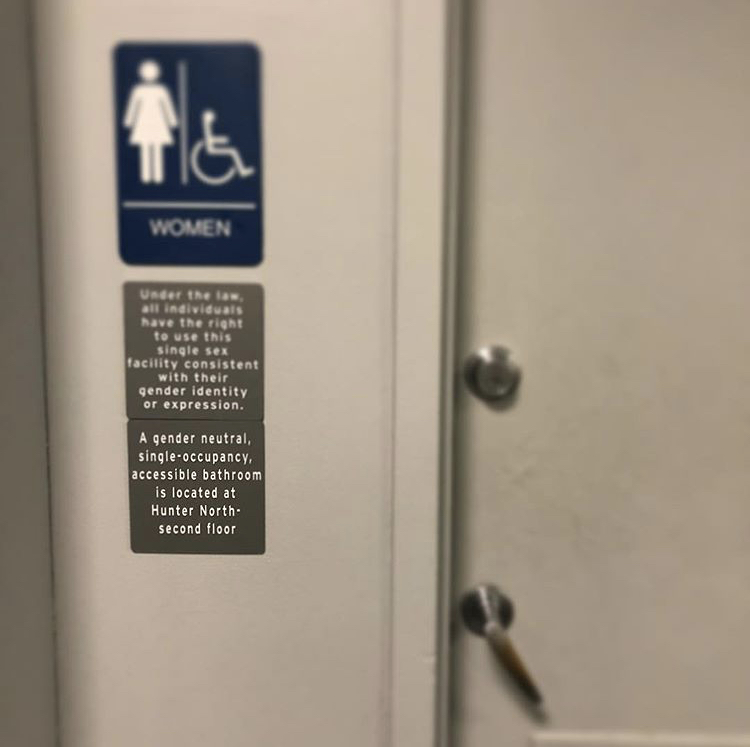
Out of the dozens of restrooms located on the main campus of Hunter College on 68th street and Lexington Ave, there are only three gender-neutral bathrooms on campus. This has caused an outcry amongst the LGBTQ+ community, demanding that more bathrooms be gender-neutral.
Two of the all-gender bathrooms are located on the second-floor of the Hunter North building and one of them is on the third floor of the Thomas Hunter building.This often poses as inconvenient to gender-nonconforming people such as Marc Roy, who says, “…getting to them from any other building is a hassle. There’s sometimes a line, sometimes they’re being cleaned. So, for a gender non-conforming person, it can be a real hassle to not be able to use the bathroom all the time.” This may also prove to be bothersome to transgender people as well. Ryan de Vita Silva, a member of the Advocates for Queer Inclusion, Policy, and Safety, said that using a single-sex bathroom can be awkward for someone that is in the middle of transitioning and may be unsure of their sexual identity. The LGBTQ+ community has even issued a petition in support of establishing multi-stall gender-neutral bathrooms, which has one-hundred and thirty-six signatures thus far.
With support for such a movement also comes opposition. A male cisgender freshman at Hunter College, who name will remain anonymous due to fear of ostracization, said that establishing gender-neutral bathrooms on campus could pose a threat to women and their privacy, since they would be sharing the same space as men.
Despite the controversy surrounding this, a spokesperson of Hunter College has since responded to the statements at hand, saying, “Hunter College is committed to maintaining a welcoming and inclusive campus. All bathrooms on campus are open to students to use consistently with their gender identity or expression. We have posted signage in public areas on campus to make sure the entire Hunter College community is aware of that policy… As we begin modernizing and expanding bathroom facilities on campus, this topic will be considered as part of that process.”
#MeToo Conference: A Narrative Observation
Publication Date: 10/9/18
October 6th was a day characterized by the different hues of gray that littered the daylight sky as well as the sullenness and despair that seemed to become more and more tangible with every breath. The air was thick with humidity and shame, as people struggled to inhale all the moisture through their sinuses. Within this space of sadness and concern was a glimmer of hope, however. Everyone gathered together in this conference room with bland white walls, drab grey carpeting that is coarse to the touch, and high ceilings adorned with large windows. The room was packed with people: some sitting in thin black wooden chairs, some sitting on cold granite countertops in the back of the space, some even sitting on the carpeted floor
They were all there for the “#MeToo and Epistemic Justice” conference on the ninth floor of the CUNY graduate center, in which professors such as Alison M. Jaggar, Suzanne B. Goldberg, and Susan Brison shared their own experiences pertaining to advocating for victims of sexual harassment and sexual assault. People’s gazes were transfixed on the powerful figures standing before them, whose innate bravery illuminated through their strong spirits. As they heard echoes of hopeful words spoken by the prophets of womanhood, echoes of gut-wrenching despair and national shame ricocheted off the chambers of their souls simultaneously. People’s iPhones started to buzz and light up, revealing through the News app that Brett Kavanaugh was officially confirmed to be a justice on the Supreme Court.
Despite the day being littered with both uproarious triumph and pride as well as heartbreaking disappointment and worry, one theme remained consistent throughout the conference: it is important in this day and age to grab onto hope, hold it tightly, and never let it go.
Weekend Reporting: 9/11 Story (Pitch)
By Hannah Kavanagh
Sept. 11, 2018

It’s human interest story that starts off by talking about the people gathered at the 9/11 memorial and around the Museum of Jewish Heritage and the details of both events. I then interview everyday New Yorkers about their experiences on that dreaded day seventeen years ago and their thoughts on it.
Notes: It was around 7:30pm at theMuseum of Jewish Heritage. There were barely any people there on Tuesday, only around 20-30 people. Admission to the museum was absolutely free that day. The lobby was empty despite the fact that the Museum put a candle in their lobby to mark the area as a contemplative space where people could go and pay their respects. With the exception of the receptionists and security guards, there were maybe two people in the lobby. The fact that it is also a Holocaust museum added even more melancholy and sullenness to the event. The 9/11 memorial was different in the sense that there were a lot more people there, hundreds actually. There was a sense of unity and New Yorker pride at the memorial that the museum was clearly lacking.
Quotes: While I was talking to Gerry Braceland (white man in his mid-40s from Ridgewood in Queens), he talked about where he was at the time and how people remembered it. He said, “I was my apartment in the East Village between 5th st. between Avenue B and C. I had a direct view of the towers from my window and I saw them. I heard a bang while I was sleeping, but I thought it was a plane crashing on the ground. Then I heard a collective scream. I looked out the window and I saw that the first tower had caught on fire. And I thought that it must have been an accident. But then I turned on the TV and that’s whenI was the second plane hit and I realized that it definitely wasn’t an accident.” He then talks about how he felt the city changed as a result of what happened, saying, “I think it unitedNew Yorkers. I think then people came together. I..uh…I don’t know now. Under the Trump administration, I don’t know how united people are anymore.” He then said that “..it’s important to remember that they’re terrorists. They’re not Muslims, they’re terrorists using religion as an excuse to do horrible things. It’s important to keep a clear head…It helps you to put your life in perspective of what’s important and what’s not important. Kids need to put themselves in other shoes and understand. What people can take from it is valuable.” He also talked about how he felt at the time as well, saying,“I thought that there was going to be a third World War. I thought the US was going to strike back at the Middle East and I was terrified…It’s important to put into perspective the fact any city can be hurt by this.”
I then talked to Madeline Kavanagh (white woman in her early 50s from Brooklyn Heights) reflects on when she first found out about the terrible event and where she was that day, saying, “I was on the treadmill at the NYSC in Manhattan while watching the news on NY1. I saw the Twin Towers fall, but I thought it was a scene from a new movie. I didn’t realize it was real. I didn’t realize the Twin Towers had been hit, until people started to gather around the TV. I was in disbelief and panic set in.And then all of the phones were down so I couldn’t contact anyone. I had to head over to Queens and Manhattan was like a war zone…god, it was so long ago yet it seems like yesterday.” She then said that she thinks “…people are more on edge [now}. People couldn’t relax as much after that happened. Before, when people heard a bang as they walked past the street, they would keep walking. Now, if people heard a bang, they would flinch. It’s not as safe as it used to be and it’s never really been the same since. I’m getting emotional talking about it now, isn’t that terrible?” She then said that young people should know that “…a lot of people died and suffered that day. It should be a national holiday, I’m surprised that it isn’t yet.”
Yahya Jeffries-El (a man in his mid-40s currently living in Times Square) was one of the last people I interviewed. In terms of where he was, he said, “I was just about to leave for work. Smart phones didn’t exist and home internet was dial-up. You had to check the weather forecast on the morning news before you left home for the day.Especially in September where it might still be summery—or chilly enough for layers. The news that morning was showing a smoking hole in the side of one of the towers. My roommate said a helicopter or something crashed into the building. I remarked at how rare that is in NYC, considering all the skyscrapers and air traffic. We lived in (a loft above a carpet warehouse in)Williamsburg, Brooklyn. Those high-rises on the waterfront were years from being developed—so most buildings in Williamsburg had nice, unobstructed views of the Manhattan skyline. After seeing the smoking tower on the TV screen, Danny and I shot up to the rooftop to witness the scene live. Other than the long plume of black smoke billowing to the south, the sky was perfectly blue that day. Which is why Danny and I were astonished to see another plane flying almost directly inside the horizontal plume of black smoke.” He then talked about how the city changed since then, saying, “There was heightened fear and heightened violence. For a while thereafter, any brown person with straight hair was liable to be attacked, beaten, stabbed by a mob. Delis owned by anyone of Arab descent decorated their establishments with American flags. The subway —New York City’s lifeline— was completely shut down. A fair amount of people who came to the city to take a chance with their future suddenly relocated—as soon as planes were allowed to fly again. Broadway theater and musicals —almost entirely reliant upon tourists (foreign and domestic)—suffered brutally. And we saw the site smoking for weeks after the buildings came down. People were shocked, sad, afraid and struggling to restore normalcy.” He warns people to “…be aware that any of us are susceptible to monumental tragedies.”
Details: At the free admission event to the Jewish Museum of Heritage, I was the only person of color visitor in the museum that was there. Most people were White and of Jewish descent. You had to walk through a metal detector and have your bags searched before you walked into the museum, a process often reminiscent of the post-9/11 era. There were two men in the lobby sitting down and scrolling through data on their phones, completely ignoring the candle that burns ever so brightly for all the victims lost 17 years ago. Only one person other than myself came on her own, a short young woman around 5’ 1” walking around wearing a denim jacket. She looked deep in thought and she carefully looked at each piece at the exhibits. There was also an old man and a younger woman (presumably grandfather and granddaughter or even father and daughter) watching a video on a huge projector at the museum. The older man was looking up at the screen tiredly while the young woman was flicking through a blank white pamphlet. A family of four or five were on the second floor of the museum laughing about something and you really saw the closeness of that particular familial unit. The security guard kept following me around the museum, at first out of suspicion…but then out of intrigue. The 9/11 memorial was eerily gorgeous as all the names on the memorial were adorned with notes, lovely bouquets, and mini-American flags.There were people. Of all different ethnicities, ages, and nationalities at this event. I heard multiple languages being spoken at once, from Spanish toRussian. There was a couple cuddling each other to my right, admiring the gorgeous beam of angelic light coming from within the memorial itself. To my left, there were two women (one black, one white) dressed in business attire and heels, talking and laughing about their work and social lives. It seemed like more of a time to celebrate unity and being in New York for most rather than a time of sorrow and mourning. The weather outside was around 75 degrees, which I would consider optimal weather. The city was lit up by the shining TwinTower lights and the luminous light from the 9/11 memorial. The sky was a little bit cloudy and had a beautiful hue of midnight blue. About sixty people were lined up by a nearby fire station to pay respect to the fallen firefighters of 9/11 as a street light lit up the pavement they stood upon.
 Hannah Kavanagh